A pipeline robot may spend hours inside a dark steel tube, far from a person and often without a live video feed. The next advances will help these machines find damage, reach more sections of pipe, and return inspection data that engineers can check.
- Robots that inspect without stopping product flow
- Sensors that find cracks beneath coatings and rust
- Machines that can recover when the pipe changes shape
Better inspection inside live pipelines
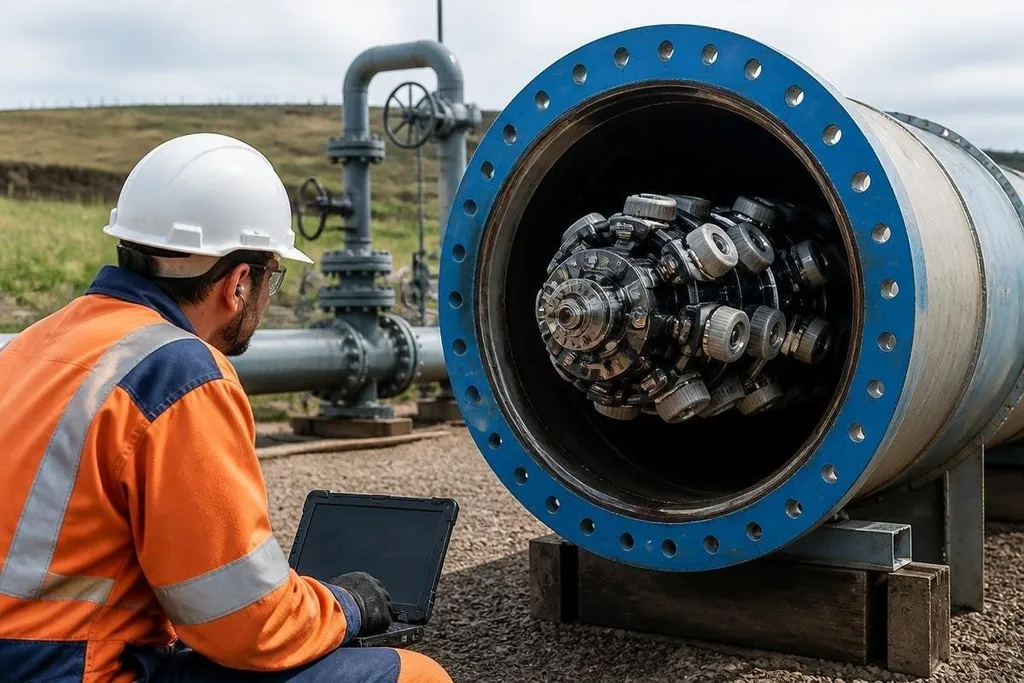
Many pipeline robots work as in-line inspection tools, often called “smart pigs.” They travel with the product flow and carry sensors that check the pipe wall while the line keeps running.
The hard part is keeping the robot moving at a steady speed while it passes bends, valves, welds, and changes in pipe diameter. A useful step forward would be better control of that movement.
The robot needs wheels, seals, and a drive system that can keep contact with the pipe without adding too much resistance. If it moves too fast, the sensor may miss damage. If it stops, the operator may need to shut down part of the line to retrieve it.
That matters to an operator because a robot that works during normal flow can inspect more often, with less disruption to production. The claim still needs proof from field records, not a clean test section in a laboratory.
Sensors that see below the surface
Pipeline damage can sit under rust, paint, or a protective coating. Magnetic flux leakage sensors use a magnetic field to find changes caused by metal loss. Ultrasonic sensors send sound into the pipe wall and measure the returning signal. Each method sees a different type of problem, so one sensor rarely answers every inspection question.
Better sensor placement and clearer data may matter more than a new sensor name. A robot that keeps a steady gap from the pipe wall can produce readings that are easier to compare across inspections. That can help engineers spot a change before it becomes a leak.
The open limit is material and geometry. A sensor may work well on clean steel but give weaker results through thick coatings, heavy scale, or a rough weld. Any serious product claim should state those limits beside its detection results.
Robots that handle damaged or changing pipe
A pipeline robot must deal with more than straight sections. Bends, branch lines, valves, changes in diameter, and deposits inside the pipe can all block movement. A tethered robot can receive power and data from outside the pipe, while a free-moving robot has more range but may be harder to recover.
Self-righting movement is another area to watch. If the robot loses traction, it needs a way to regain contact with the pipe wall or send its position to the operator. That recovery plan matters as much as the normal inspection run, because a trapped robot can become a maintenance problem of its own.
A pipeline robot’s inspection record should show the pipe diameter, wall condition, sensor, speed, and test date. Robot24.com can put those details beside the machine’s result, so a lab run isn’t mistaken for proof that the robot can inspect buried pipe in the field.
Data is part of the robot
Inspection hardware only helps when the results reach the people who make repair decisions. The robot needs to record sensor readings with location data, then connect those readings to the pipe section they came from. A report that cannot show where a defect sits has limited use, even if the sensor worked well.
Software can also compare new readings with older inspection runs. That may help an operator see whether metal loss is growing, but the comparison depends on repeatable speed, sensor contact, and location data. Those conditions need to be checked for each pipeline rather than assumed from a product sheet.
I’d watch field recovery rates before buying into any headline about autonomy. A robot that finds defects but cannot return safely has not solved the whole inspection job.
A practical buying checklist
Use these questions when a pipeline robot moves from a demo toward a paid inspection:
- Pipe fit: Which diameters, bends, valves, and branch lines can it pass?
- Inspection method: What damage can the sensor detect, and what materials block it?
- Speed control: How does the robot keep sensor readings steady during flow changes?
- Recovery plan: How will the team locate, stop, and remove the robot after a fault?
- Data record: Does each reading link to a clear position on the pipe?
- Field proof: Has the maker shown results from the same pipe type and operating conditions?
The final proof point is a public inspection record that connects sensor readings, robot recovery, and repair decisions in one run. Until makers show that chain, the most useful pipeline robot is the one with clear limits and a tested way home.